
You are using an insecure version of your web browser. Please update your browser!
Using an outdated browser makes your computer unsafe. For a safer, faster, more enjoyable user experience, please update your browser today or try a newer browser.
My dear husband, Karl, is 25,000 days old today! I know, it isn’t a normal day of celebration – or even a day we normally take note of – but maybe it should be. Just think about it: 25,000 sunrises and sunsets. 25,000 chances to do your best, discover all you can, enjoy this world, be useful, productive. To love and be loved.
I can tell you with authority, because I’ve been married to Karl for 15,150 days out of those 25,000, (that works out to 3/5th of his life!) that I’ve watched this guy through the good days and bad, and I’m continually amazed and impressed with how well he has managed to use his time. He certainly isn’t perfect, and in his mass of days there have monumental fails, but all in all, I’m thinking there’s more to celebrate than to whisk under the rug.
Every day is an adventure, and I’m thankful to have been on this journey with this terrific partner and friend. So, Happy 25K, Karl!
I stepped out of my truck yesterday, in the garage, and hit a slick of ice. Both feet went flying and I came down hard as my left hip made contact with the truck’s running board. Dang. That hurt. Took my breath away for a moment. My fanny hurt all day. When I got dressed for bed last night, I expected a humongous bruise to mark the spot. Nope. Nothing.
I feel cheated. Not that I would be showing it to anyone, but I feel like I deserve to have a token for my trouble. There should be hues of blue and black in a banner across that cheek as a talisman to my near-death experience and the pain that has lingered. 😉
Pain is like that, I guess. Be it a bruise on your back side, a broken heart, or a difficult diagnosis. Some pain leaves an outward mark, most pain doesn’t. It’s a reminder to me to treat others tenderly, since we don’t know where they are hurting.
Not long after Karl and I got married, my sweet husband made a request. It was something to the effect of: “As my wife, I would really appreciate it if you would make sure that my jeans are ironed. I like them to have a crease.”
Honestly, I like to iron and that didn’t seem unreasonable. I did counter him by saying that I thought, in exchange, it would be terrific if he’d make sure my car always had a full gas tank since I hate pumping my own. Deal made. Everybody happy. Mostly, we’ve both held up our own ends of the bargain. Again, everybody happy. OR so I thought.
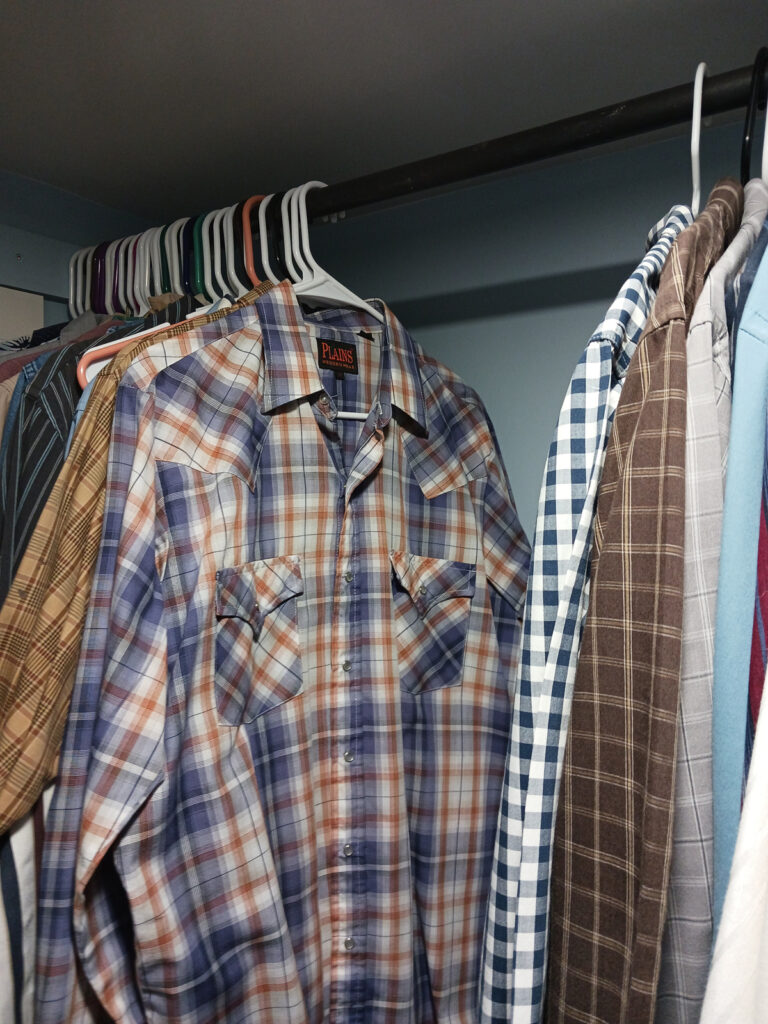
Oblivious to any problems, I was ironing his jeans and shirts not long ago when my sweet husband looked at me with a touch of a frown. “You do know, don’t you, that you always hang my shirts up wrong?”
Huh? Isn’t there only one way to hang shirts? Apparently not. With a bit more (bewildered) questioning and conversation, I ascertained that what I had been remiss with (for almost 42 years it seems!) was the direction his shirts are facing after I’ve ironed and hung them. I always face his shirts toward the left when they are hanging in the closet. With his patient redirection and correction, I now know that is wrong. Karl prefers that the buttons be on the right.
I’ll admit, since receiving that ‘talking to’, I’ve had to rehang several shirts to correct my errant ways. The thing that haunts me, though, is why it took him 41 years and 5 months to bring the subject up?
I’m proud to admit that I have never, in any of my novels, used the word cacophony. I’ve used lots of words, but this one does not join membership in my club. Why? Hmm. No one anywhere in my realm ever uses the word cacophony in daily conversation. I’ll bet real money you have never heard your gramma say, “You kids stop that cacophony and quiet down!” I’m quite certain you haven’t heard it spoken on a television commercial or in a radio news cast. I haven’t.
So why am I boastful that I’ve never written the word in one of my novels? Simple. Everyone else does. Maybe not everyone, but a grand majority of writers feel the need to employ this non-conversational word within the pages of their books. This fact is a source of mirth for me. Even renowned and popular writers succumb to the word’s allure. Why? I’m not sure. Perhaps they deem it worthy because it’s long and looks erudite. On the surface, it’s interesting, attention getting, I’ll give them that. Whatever the reason, cacophony populates pages on a regular basis. The one thing I am sure of is this: every time I locate and note the presence of the word on a page, I feel like I’ve found Waldo.
I’m wondering, now that I’ve mentioned it, described the red striped shirt and dark funny glasses of this word, will you start finding it, too?
I’m a get it done sort of person. I don’t like inaction. If it’s broke, fix it. If it can be better, improve it. That said, it’s interesting that in recent months, I’ve been encountering situations that seem broken or in need of improvement and for a variety of reasons my only recourse has been inaction. Frustrating, anxiety-inducing inaction.
But then. The Bible study that Karl and I are doing together, coupled with my own personal reading of Psalms and of Mark and several long, searching conversations with someone I respect deeply, have begun teaching me a new perspective.
Consider Jesus’ lack of action as He stood in front of Pilate. He didn’t call down angels, He didn’t explain that all of creation was, in fact, His doing. Nope. He stood. When Pilate asked Jesus if he was king of the Jews, Jesus answered “You have said so.” Pilate wasn’t satisfied. He asked again. Mark 15:5 says “But Jesus still made no reply.” Was this weakness? Was this shirking? For someone like me it could seem so. Why didn’t He act? Oh. The result of His silence and seeming inactivity was my salvation. Your salvation. A crucifixion and resurrection that covers the sins of the world.
Yikes. Here’s the lesson: sometimes, inaction isn’t the same as complacency. Sometimes, sitting back and waiting for a situation to play out without my help isn’t weakness or shirking. Sometimes keeping my mouth shut and my hands still is what is required. Sometimes choosing to wait and be patient is the right course of action.
This is a hard lesson for me. One that demands that I put my trust in God’s sovereignty. One that requires me to trust in Him not me.
When I taught fifth grade science, we did a unit on energy. I always enjoyed one particular lesson. I had fun putting a rubber band on each student desk and asking them to just look at it. Just a mangy old rubber band. Nothing to see here. Then, to their delight, I’d ask them to pick it up, stretch it, and aim it at a target I’d set up. (NO! Not your neighbor!!)
Here’s when the lesson really began. While they held the stretched rubber band at the ready, I explained the definition of potential energy. Then, of course, we counted down and shot the bands (with a prayer on my part that no eyes were put out) and the lesson concluded with defining kinetic energy – what moves the band through the air and to the target. Fun.
The difference between the desk-bound, untouched rubber band, the stretched one, and the soaring one has captured my thinking of late. Which state of the rubber band holds the most power? Certainly, a case can be made that the airborne band launched with glee and moving freely through the air is expending its energy and has the most power. But let’s leave the rubber bands on the desk for a moment and talk about people.
The Bible tells us to put on the full armor of God: helmet, breastplate, belt, shield, sword, good shoes. That seems to me a great deal of potential energy, stretched and ready. But what comes next in Ephesians 6 is the surprise. After carefully dressing and arming oneself, the next bit should be what my 5th graders wanted, the unleashing of the power. I’m dressed in armor for heaven’s sake (literally), now let’s go kick some…
Nope. That’s not what comes next. The next sentence is the mandate. “Stand.” That’s it. Stand. Stand your ground. Be strong as you stand. Pray and be alert. Don’t shoot that band, just hold the power. What? I didn’t get all dressed up just to stand here! I want blood, battle, triumph. What good is power if I can’t use it?
I’m working through all the ramifications of this, but one thing I’ve come to understand recently – sometimes it takes more power, faith, and submission to the Lord to stand still. Waiting patiently for God to act is a strong, powerful choice. 2 Chronicles 20:15 says it best. “This is what the LORD says to you: ’Do not be afraid or discouraged because of this vast army. For the battle is not yours, but God’s.’”
Random observation: I’m so thankful that God didn’t see fit to make me a woodpecker. Seriously. We’ve just spent some time in the mountains, and as I sat in my hammock one afternoon, I watched a grey and black woodpecker as he worked his way up a nearby tree. What kind of padding is inside that bird’s head that allows him to whack his beak over and over on a daily basis into the hard trunk of a tree and not end up addlebrained? From my cushy swinging sanctuary, I considered this. (I actually took a bunny trail of thought for a while, thinking that if the NFL commissioned a study about how God protects a woodpecker’s brain from concussion and then followed that science, maybe a new kind of helmet could be developed for its players.)
Digressions aside, I also considered how, in addition to the constant wear and tear on cranium and skull, if that isn’t enough, what the bird the net gain for his efforts is a bug for a meal. A bug! Yikes.
I watched my feathery companion for a while, secure in the knowledge that as one of God’s creations, he was wonderfully made. I did thank God that I, too, am wonderfully made. And another bunny trail presented itself. I’m not a woodpecker. But. How many times do I bang my head- both figuratively and sometimes literally – on problems in my life that at best will yield me something with the worth of a bug? Often. I stress and stew, expending energy and emotion on things that I could so easily surrender to the Lord. So, random thoughts from my hammock. Don’t be a woodpecker.
So, you’re going through a hard time. A well-meaning friend at church, offering comfort and encouragement, reminds you of Romans 8:28, quoting kindly, ”And we know that all things work together for good to them that love God, to them who are the called according to his purpose.”
You smile and thank the person for their shared wisdom. Somewhere inside you understand that there is Truth and good intention in the reminder, but in reality, hearing that verse doesn’t fix a darn thing. You love God with all your heart, but your jaw still aches from gritting your teeth, your stomach is still upset, and the problem is still there. Sheesh. Bible verses aren’t supposed to be platitudes we lob at each other. The Bible is a guidebook, an exhortation to aspire to grow and become better than you can be alone. The verses within offer comfort and courage and advice.
The chaotic trainwreck of your situation may be keeping you from grabbing hold of the advice and the peace offered in the Bible because it doesn’t take much effort to look around and see a host of situations that did not have happy endings. It isn’t Biblical Truth that is the hinderance, though, and this is THE most important idea to grasp.
What keeps us from finding peace in God, and in His word is our attitude. I was watching a show recently that included an interview with Demi Moore. I’m not a huge fan of hers, but something she said really resonated: regarding the events in a person’s life, she said
“Everything is happening for us, not to us.”
Interesting perspective, right? How differently would we react to life’s difficulties if we truly embraced this idea? If we could hold fast to the conviction that God isn’t out to get us, but that all that we experience is for our growth and good, wouldn’t those hard times be easier to maneuver?
As I mentioned, I was in Virginia In June helping my bonus daughter, Amanda, and her husband Jarrett and their two year old welcome their new baby. Jarrett’s parents came to celebrate Father’s Day and meet their brand-new grandson so I decided to give them some space and avail myself of my surroundings and geek out on history for the day. I started out at Sailor’s Creek Battlefield, a place (and Civil War battle) I’d never heard of before. Turns out, nearly 7,700 men died on April 6, 1865 in three related skirmishes at Sailor’s Creek. Just three days later, as a direct result of his losses and the Union’s position cutting off Lee’s escape to the mountains, Lee surrendered to Grant at Appomattox Courthouse.
I imagine that on some level it is inappropriate to describe my tour of this battlefield as peaceful, beautiful, and lovely. As I explored a nearly one-mile walking trail around one of the sites of heavy fighting, I was acutely aware that I was treading ground that had claimed countless men’s lives. I stood for a long while in the shade of a grove of trees at the bank of Sailor’s Creek fully recognizing that the Confederates had gotten bogged down at that exact spot and became ‘ducks on a pond’ for Union artillery and a wall of Minié balls (lead bullets from muzzle-loaded rifles). At the top of the hill, a handsome two-story white house called the Hillman House, stood peaceful watch as I walked the grassy, loop trail. It’s a pretty, inviting house, one with character. That house has stood watch over that little valley with a view of the creek since before the Civil War, and in April of 1865 it shuddered with each boom of the Union cannons positioned nearby, and the floorboards of the living room became indelibly stained by the blood of both Union and Confederate soldiers as it was transformed into a field hospital.
Still, my walk was beautiful. Peaceful. Pastoral.
As I enjoyed the battlefield and then drove along the route Lee used in his final retreat to Appomattox, I couldn’t help but think about Lee and Grant. Biographies of both men detail each man’s faith in God. Both men believed in the cause they took up and were convinced they were acting according to God’s leading, each asked God’s blessing and help. Since Lee was defeated, does that mean his faith was somehow inaccurate? I don’t know. We can look back with certainty that slavery was wrong and with conviction that the United States is better as one country rather than two, but that doesn’t explain how both generals could truly have been men of faith and been on such opposite sides.
There are lots of Godly, faithful people with opposing ideas about things. Read the news. Listen to your neighbors. Go to church. Thoughtful, sincere people with opposing views abound. Who is right and who is wrong? On some issues it may seem easy to discern what is right. The Bible is very clear – sometimes. But on others, not so much.
Perhaps we won’t figure it all out until we meet Jesus face to face. I’m certain everything will be clear then. Until that time, the best we can do is follow what the Bible says as best as we can understand it, listen to the Spirit within us, and pray like crazy.
One more thought about Lee and Grant. During the official surrender ceremony, Union general Chamberlain ordered his troops to salute as the Confederates approached. The Confederate Army responded in kind. “Honor answering honor.” I love that. I’m sure nothing was different in the hearts of the men. They still believed what they believed, that hadn’t changed. They just had the integrity to respect the other side and lay down their arms and look for a way to live together.